On the waterfront
Geoff Andrew / Sight and Sound – November 2023
Nicolas Philibert’s perceptive, patient and sympathetic documentary examines a Parisian day centre for people who are dealing with issues around their mental health.
The stark double-verb title of Nicolas Philibert’s Être et avoir (To Be and to Have, 2002) suggests not only his abiding interest in language and communication, but the interrelated themes central to his documentaries. First, what it means to be alive, and be identified as a certain kind of being. Second, what being alive brings us: not possessions but emotions, ideas, beliefs, relationships, experience. From his early films about mountaineering and In the Land of the Deaf (1992), as well as the aforementioned portrait of a traditional rural school, through to Nénette (2010, about a 40-year-old orangutan in a Parisian zoo) and Each and Every Moment (2018, about nurses confronted with human suffering), Philibert has repeatedly returned to core questions about how we live (and why), and how challenges might be faced, or overcome.
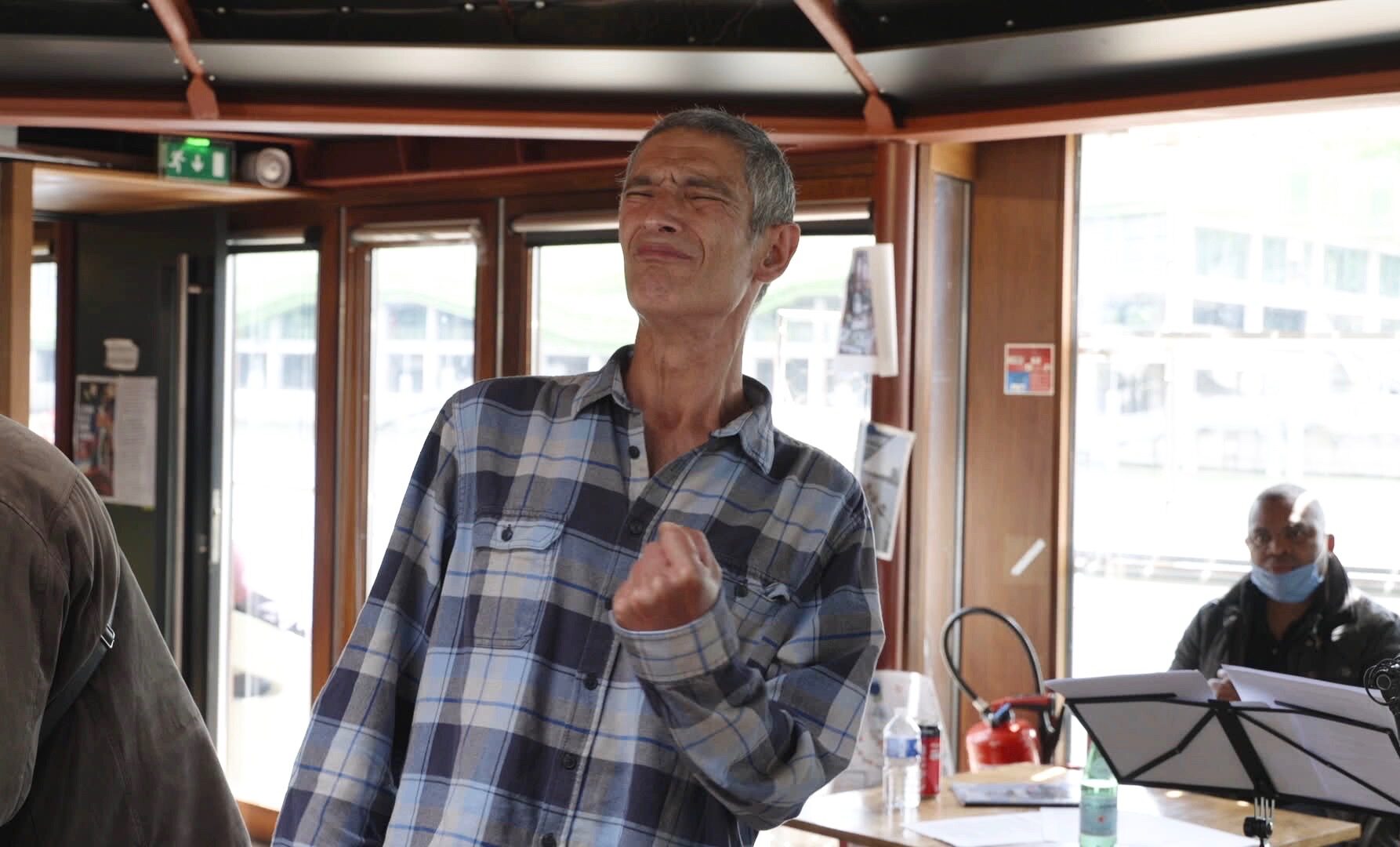
On the Adamant, the Golden Bear-winner at this year’s Berlinale, is no exception, dealing as it does with a mental-health day centre on the barge of the title, which floats on the Seine in central Paris. As ever, in showing the interplay between staff and patients – ‘les passagers,’ as Philibert calls them – the film offers no explicit judgements but simply observes, closely but discreetly, patiently and perceptively, sympathetically but without sentimentality. He’s too honest an artist to pretend his presence behind the camera – accompanied, half of the time, by a crew of three – is going unnoticed; indeed, occasionally his subjects address him directly. But as in all his films – including Every Little Thing (1997), which chronicled preparations for a play performed by patients and staff at the La Borde psychiatric clinic in the Loire valley – he lets viewers make up their own minds about what they see and hear. Still, the film clearly has a political dimension; as with that earlier work about the treatment of mental health, in its profoundly respectful portrayal of everyone involved with the Adamant day centre, it effectively undercuts many erroneous and damaging assumptions about those with psychological disorders.
Philibert first heard about the Adamant project almost 20 years ago (during its planning stages) from Linda de Zitter, a clinical psychologist he met while making Every Little Thing, who is one of the centre’s co-founders. ‘The former day-centre was, as often, highly unsuitable, so the head of Paris’s Central Psychiatric Group wanted to build something new. They brought together patients, staff and architects for discussions, and eventually the dream became reality, with The Adamant opening in 2010. I was first there eight years ago when I was invited to talk about my work – they often invite guest writers, philosophers, curators and so on. Most psychiatric institutions are very enclosed, but The Adamant is unusually open: people come and go as they want, and can go into any room for whatever workshop, discussion or activity they’re interested in.
‘The proximity to water is important, making it a peaceful place for the patients, carers, everyone. When I was filming, the atmosphere usually felt very calm, so going home across Paris I’d be struck by the cars, noise and aggressive behaviour… which shows that the craziest people aren’t always where we think they are. The Adamant, conversely, offers a culture of respect: people make a real effort to listen to others.’
That’s true, too, of the film. Philibert’s empathetic sensitivity to the vulnerable was immediately evident in Every Little Thing, but he says his approach for the new film was different. ‘When I began work on the earlier film, I had many scruples – “Mental illness isn’t a show!” – so I held back. But some people at La Borde told me, “We may be crazy but we’re not idiots. We’ll help you become more confident while filming; don’t be so afraid of working with us.” I learned from that, and this time I no longer tried to protect myself by keeping a distance.’
Philibert has always made sure to spend sufficient time with his subjects before filming starts to create an atmosphere of mutual trust. This time, however, once shooting started, his strategy differed from that taken at La Borde. ‘For Every Little Thing, I needed a structure before starting, so I decided to follow the progress of the play they were rehearsing; that was my crutch. But here I abandoned any idea of a pre-existing structure and decided to improvise as much as possible, responding to) the micro events of daily life. Making myself available that way ensured proper encounters with people. After all, it’s a film about our shared humanity. I make my films from my ignorance, my desire to lear more about the world, about the mysteries of the mind, and about myself: who I am and what I’m doing here. You said watching the film made you feel, “I could easily be like that person.” I certainly felt the same.’
Despite being shot over seven months in 2021, when Covid necessitated masks and other precautions, the film is notable for its sense of a collective spirit – a concept central to the Adamant project – and its gentle intimacy. Even more memorable than some day-visitors performing songs or discussing their paintings (creativity is clearly encouraged) are the moments when individuals open up to camera about their ‘madness’; their fears, anxieties, beliefs or inner voices. ‘What some people have in their heads is a real hell. But many are also highly intelligent. One, for instance, writes, composes and knows an amazing amount about filmmakers, writers, musicians and artists. But he also believes that many of those artists’ works are all about him and his family. Even so, those delusions can have their own strange logic.
‘These patients are hyper-sensitive to the violence in the world; it’s a kind of lucidity. They don’t have the defence strategies “normal” people use to protect themselves. Their communicative link with the world has been damaged, so the Adamant’s carers try with each person to repair that link. Doing that, it’s important to remember that while they’re ill, they’re not only ill. Firstly, they are people. Many psychiatric institutions don’t want to deal with more than their illness, but on the Adamant and at La Borde, the carers see them as individuals in their own right, who enjoy music, drawing or a walk in a forest. So they try to help them rebuild a link not only with others but with themselves.’
Clearly, the Adamant is a cherishable rarity. Happily, this film kicks off a triptych; the second and third movies, already largely shot and partly edited, will centre, respectively, on conversations between carers and patients and on the former visiting the homes of the latter. Improvisation still rules. ‘It’s like I’m saying to the viewer, “Look, that boat looks like it could be interesting. Come take a look and let’s see what we find.”